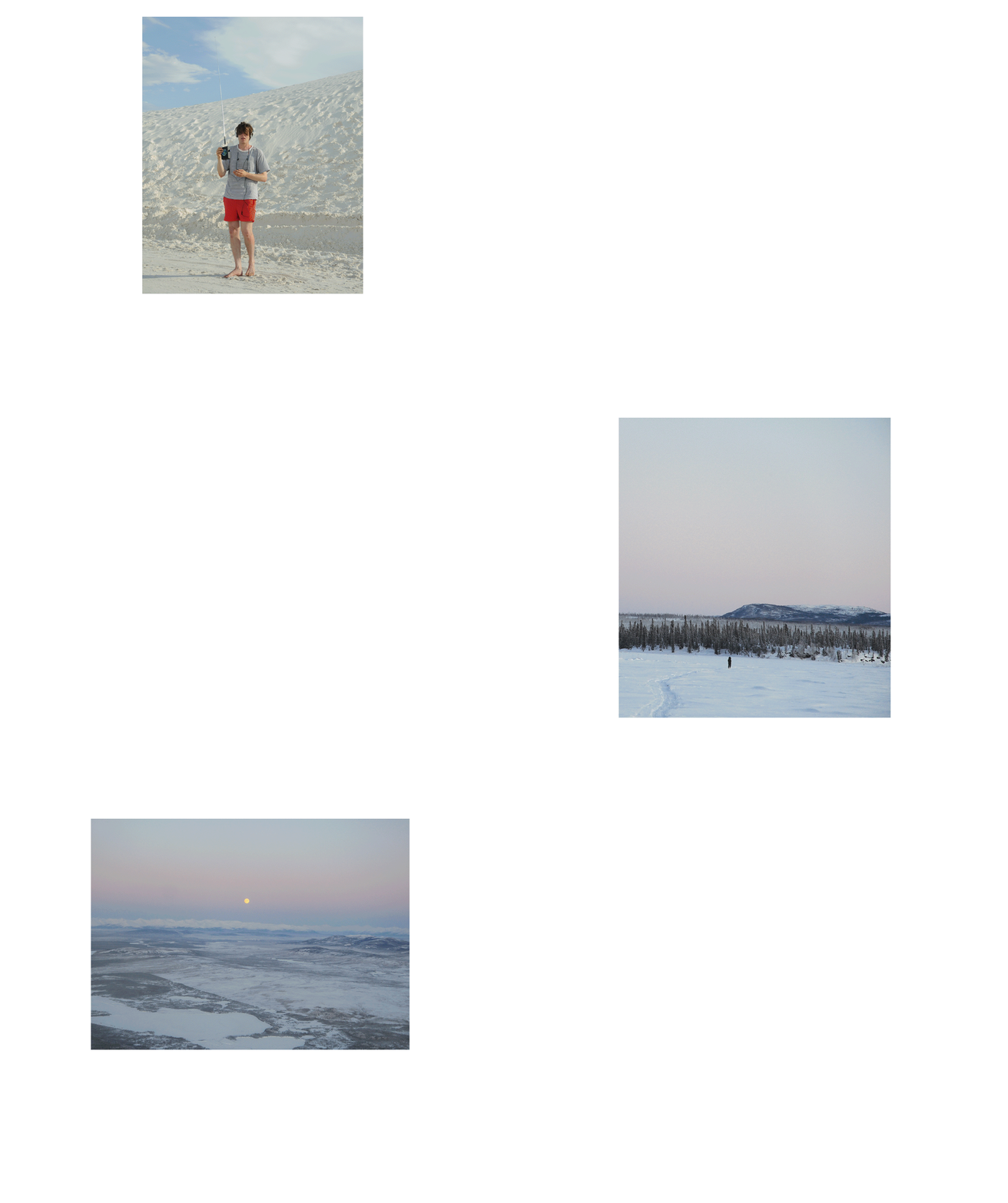
These recordings of extremely low and very low frequency (ELF/VLF) environments contain solar radiation, geomagnetic fields and naturally occurring electricity. Handheld devices with telescopic whip antennas modulate energy into a hearable range. EQ filtering on all selections was made live. No overdubs. Mono.
Heliogram
ELF/VLF signals from midges and the magnetosphere. The beating of wings causes the insects to shed negative particles from body to air, which are modulated into melodies as they swarm into the charged antenna. Recorded by Robin Watkins during solar cycle 24 on Bungenäs, Gotland ϕ 57.5º N, λ 19º E. Interrupted by ionised flecks and localised surface interference, the recording is cut short by a cellular network fragment. Mastered by Cory Allen at Altered Ear. Edition published by Run/Off Editions, New York.
Sunday
ELF/VLF signals from alternating currents, sferics and other atmospheric electricity. Recorded night and dawn 28.01.2012 – 29.01.2012 in and around the derelict power plant on Cockatoo Island, Sydney ϕ 33º S, λ 151º E by Robin Watkins. The building hosted defunct glass voltage converters, eroded cable ducts, roots and moss. Interference by man-made currents occur throughout the recording. Mastered by Martin Ehrencrona. Edition published by Mount Analogue, Stockholm.
The Luminiferous Aether
ELF/VLF signals from the solar wind, aurora borealis and other magnetic storms. Recorded day and night 09.01.2009 – 11.01.2009 in Yukon-Koyukuk, Alaska, near the Arctic Circle ϕ 66º N, λ 151º W by Robin Watkins. A variety of tweeks, whistlers and an auroral chorus begins at 14:04. Temperature dropped to − 50º Celsius. No leaks from the high voltage grid. Mastered by Scott Colburn. Edition published by Wiens Verlag, Berlin.
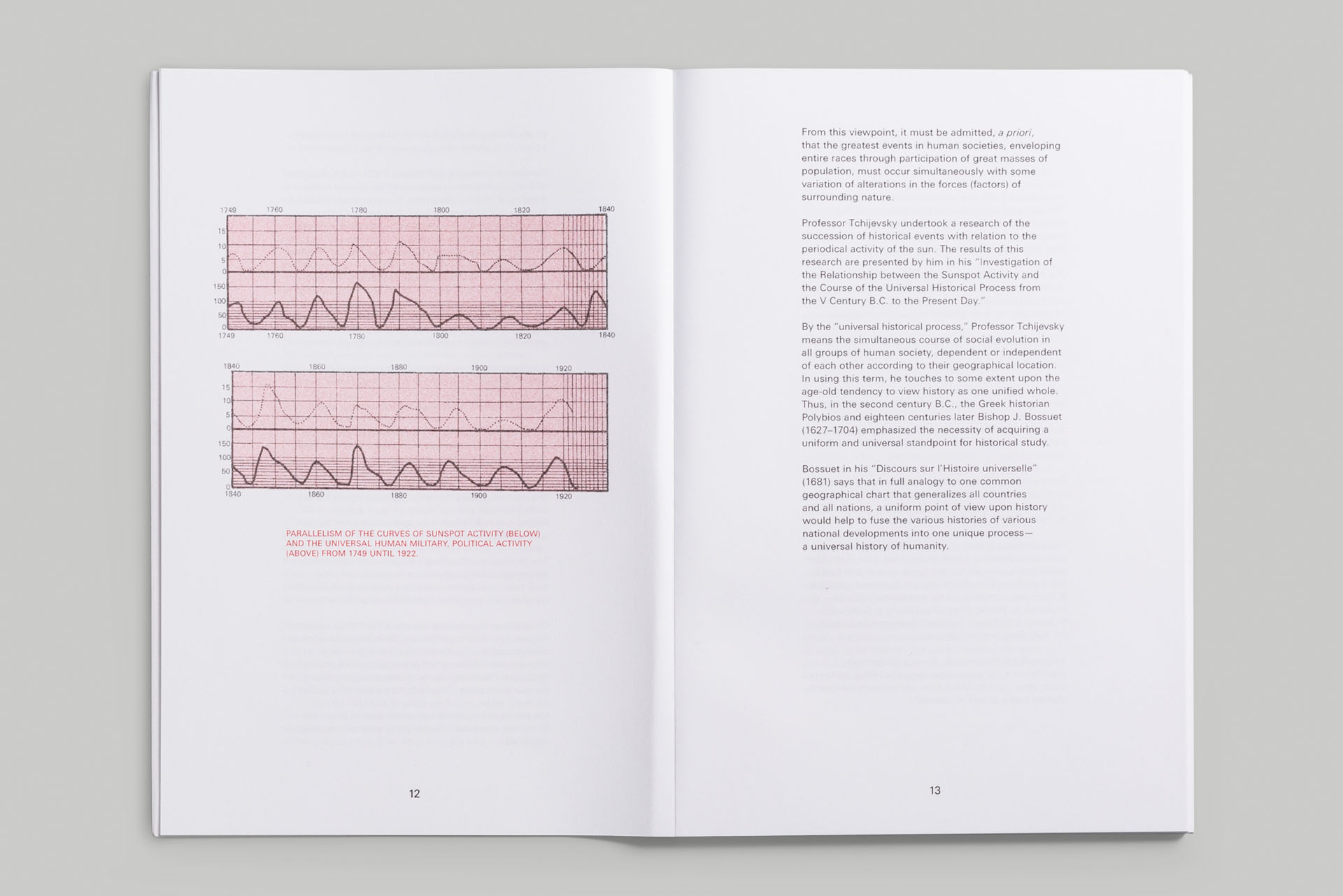
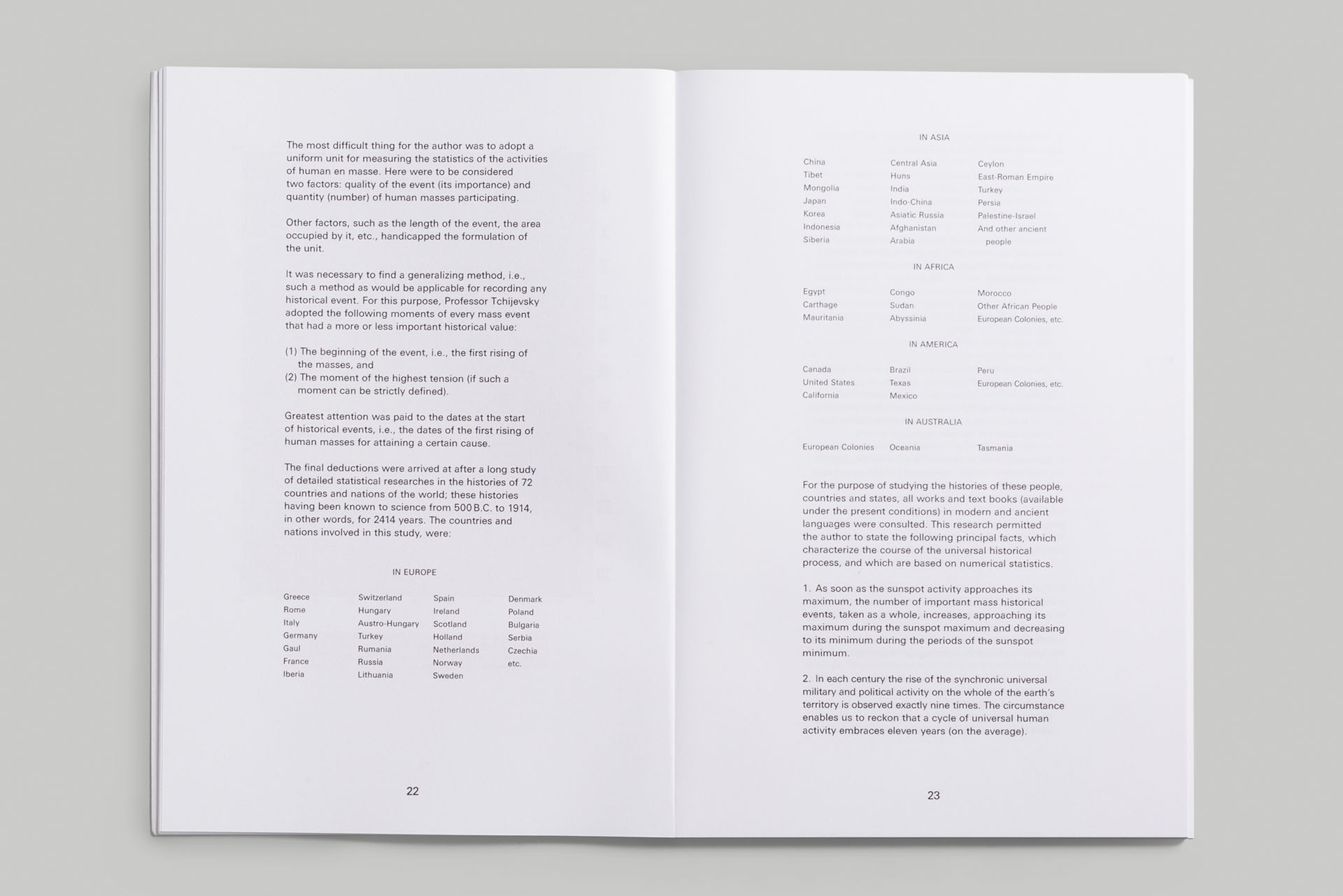
Published in 1924 by Alexander Chizhevsky, Physical Factors of the Historical Process outlines a speculative correlation between sunspots and mass behaviour, including human conflicts and pandemics. A reprint of Chizhevsky’s paper comprising original diagrams, solar cycle graphs from 1750 – 2032 and an afterword by Robin Watkins was published by Atlas Projectos in 2017. Edited by Laura Preston. Two-colour risograph print, 90 pages, red glue gauze binding in an edition of 200 copies.
Read afterword here ▼
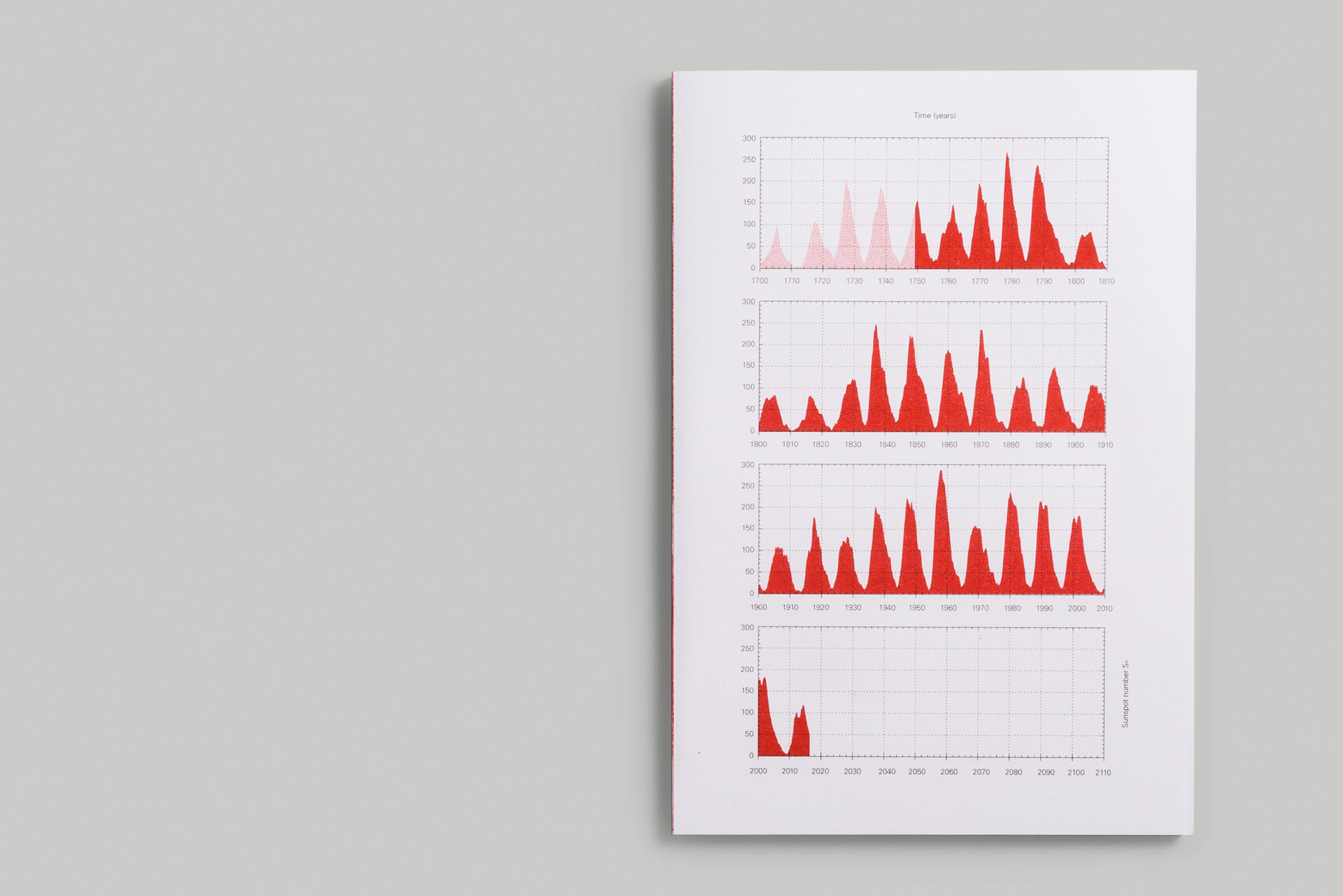

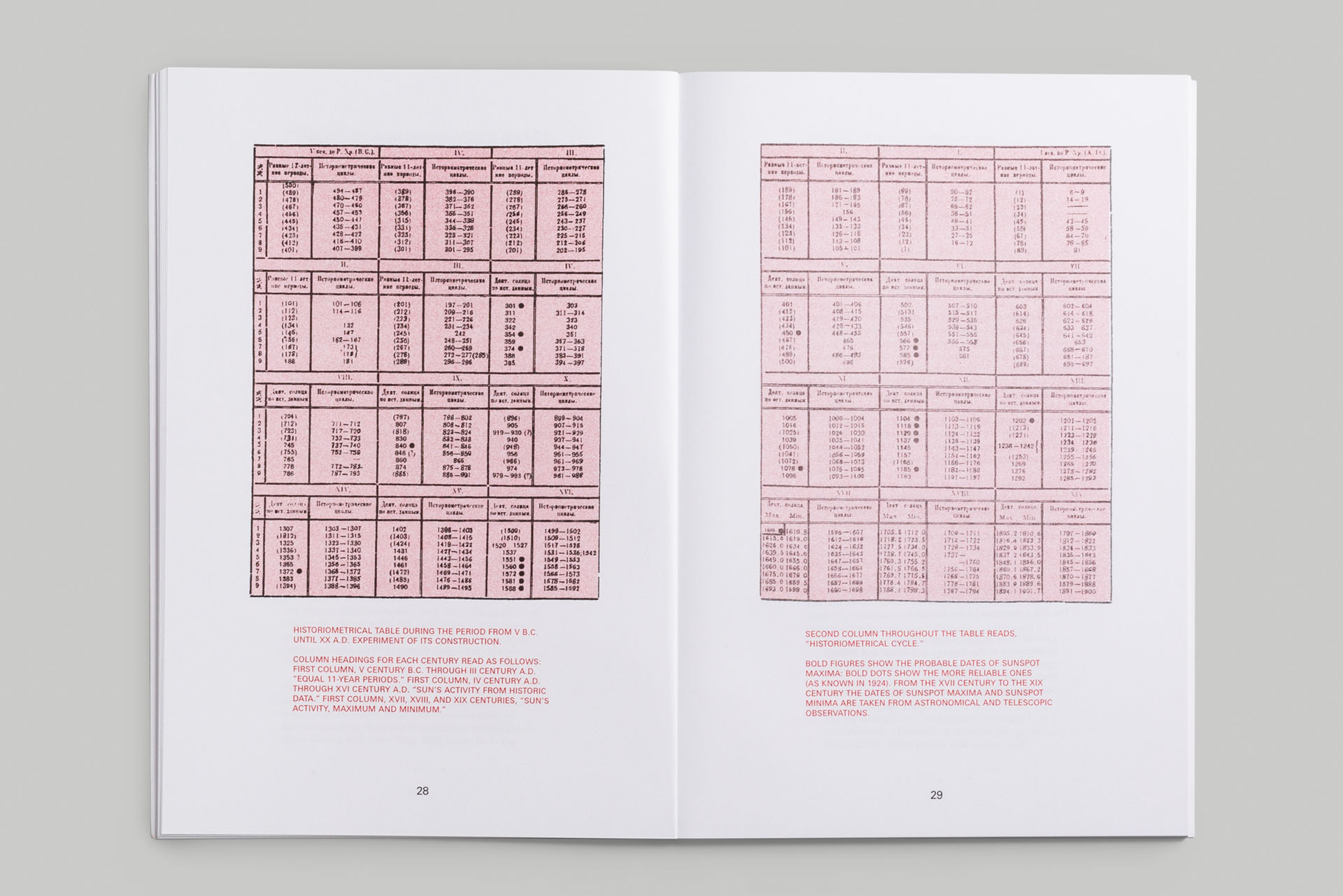
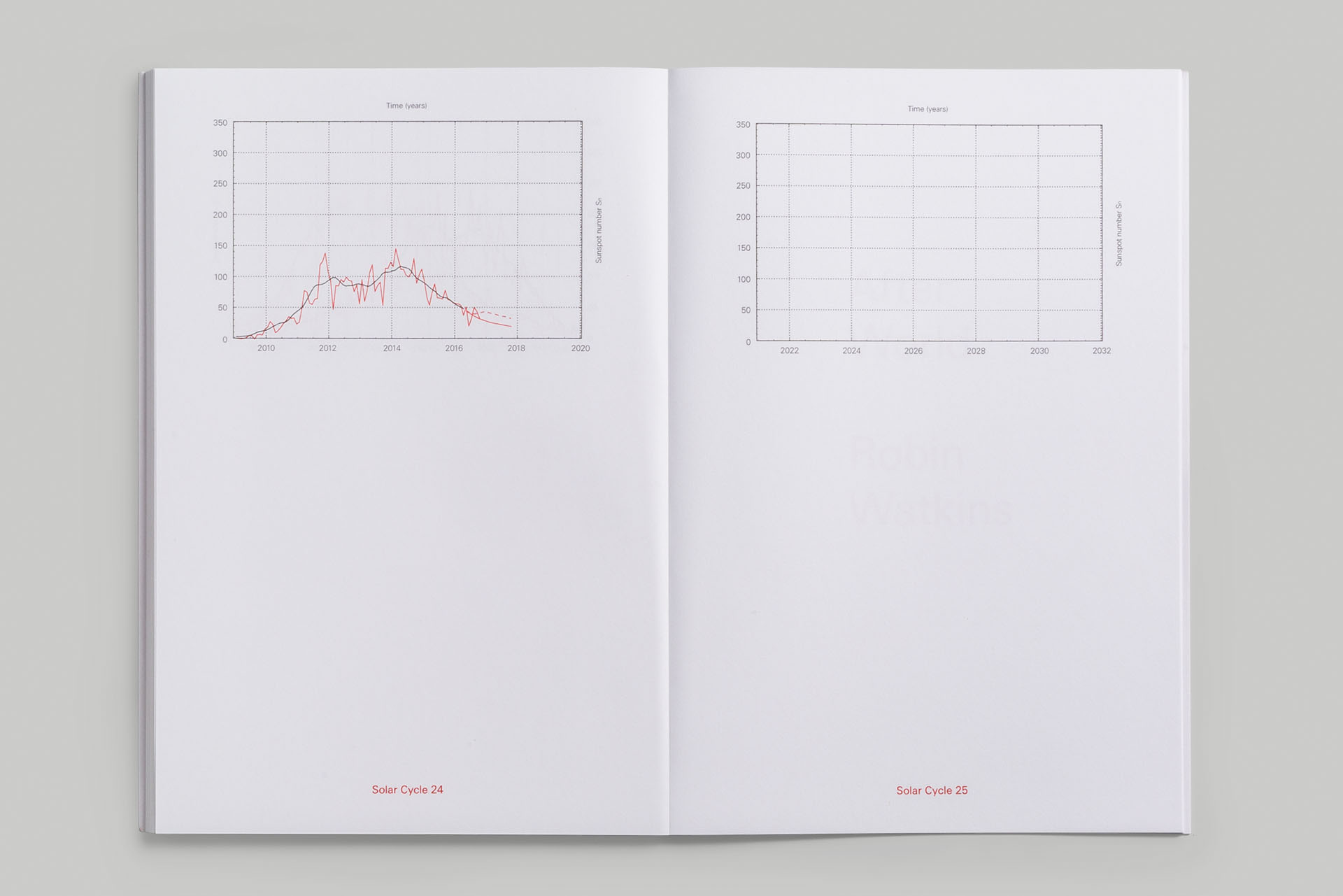
The earliest known description of sunspots can be found in the I Ching, or Book of Changes, from nearly a millennium BCE. In the past, many cultures observed flecks on the Sun’s surface, before the recurring patterns were systematically recorded. Measured by sunspot numbers, the Solar cycle registers variations in the periodic output of energy from the Sun. Today, these predictions are used by various agencies, scientists and industry groups. The forecasts give a rough reading of the frequency and amplitude of magnetic storms over the course of its 11-year cycle, which alternates between a solar minimum and solar maximum. Technological processes and systems effected by solar events include the electric power grid, high-frequency radio communications used by commercial airlines and government agencies, satellites and spacecrafts in low Earth orbit, Global Positioning Systems (GPS) and other applications critical to the functions of a post-industrial society.
Various materials, living processes, animals and plants are also under the influence of solar events. Occurring within a field of intermingling energy signatures, human experience is embedded in a tapestry of protons and electrons. Low frequency fields to high frequency gamma waves are absorbed by biological systems, and pollution in the magnetosphere caused by artificial radiation, magnetic flux or electrosmog affects the behaviour of more-than-human phenomena. The Earth system relies on a plurality of small-scale functions including those found in electrostatic environments: human skin carries a negative charge and certain microbes ingest electrons; avians navigate using magnetoreception and static fields influence how spores are distributed by wind; spiderwebs function as magnetic traps and charged dust particles in clouds generate rainfall; pollinators sense the electric fields of flowers and electrical signals tell all mammalian heart muscles to contract.
This webpage generates a graph in real-time using sunspot data from the Royal Observatory of Belgium: https://www.sidc.be/
Low frequency field recordings, texts and graphic layout by
Robin Watkins
All photographs by Robin Watkins and Nina Canell
Programming by
Fält
Published by
Canell Watkins Studio, 2017 – ∞